A Piece of Soviet Nostalgia in the Middle of Tallinn’s Skyscrapers
Text Timo Raussi
Photo Tõnu Laigu / Estonian Museum of Architecture EAM Fk 19912
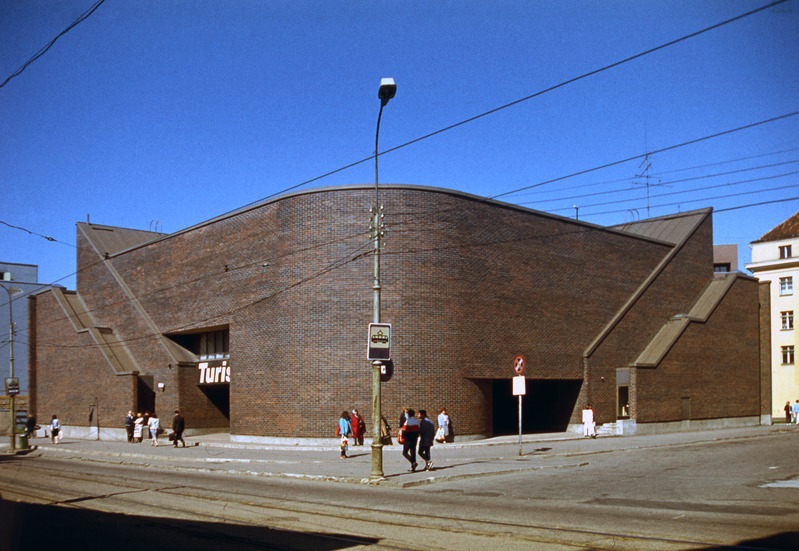
You have probably noticed the almost windowless brown-brick building with curved walls near the Stockmann department store in Tallinn. Did you know that its designers were inspired by the architecture of Alvar Aalto and that, like the Viru Hotel, it was built by a Finnish construction company largely using materials imported from Finland? The building in question is the Soviet-era foreign-currency shop, or “Turist pood”.
The building is presented in a short video by Tallinn-based young politician and city council member Joosep Vimm, who has studied contemporary history and international relations at the universities of Tallinn and Stockholm. In addition to the foreign-currency shop, he has produced more than 40 cheerful videos in the “See ongi Tallinn”, or “So This Is Tallinn” series, packed with fast-paced trivia in Estonian and fascinating archive photographs of various places and buildings in the capital.
Architects Peep Jänes and Henno Seppmann began designing the foreign-currency shop as a government commission in Soviet Estonia in the late 1960s. The aim was to complete and open the building in time for the 1980 Olympic regatta, but the wooden houses built on the site in 1889 by merchant Gustav Blauberg could not be demolished in time.
“Turist” was eventually completed in 1983. Its windowless, brick-wall-like appearance was no accident. The authorities did not want the building’s activities to disturb or attract attention among the working class. The shop sold goods that ordinary people could not buy, using money they were not permitted to possess. For Soviet citizens, holding foreign currency was a criminal offence. In addition to tourists, only certain privileged individuals were allowed inside: people whose earnings from abroad the state converted into special purchasing vouchers. Purchases in the foreign-currency store were then paid for with those vouchers.
The interior of the building, considered modern for its time, also drew inspiration from the works of Alvar Aalto. The shop featured three balcony-like levels opening onto a tall central atrium, a golden-coloured ceiling, and on the top floor a small art gallery and bar.
After Estonia regained independence, the building housed a bank, various shops, and a succession of nightclubs under different names. In 1997 the property was acquired by a real-estate development company, after which its architectural protection became the subject of a dispute lasting a couple of decades between Tallinn’s building permit authority, the Ministry of Culture, the Muinsuskaitseamet, which is a heritage protection agency, and the owners, across various levels of administration and courts.
Following the crisis years of the pandemic, the owners now appear to have gained the final opportunity and legal protection needed to demolish the foreign-currency shop building, and replace it with a 34-storey skyscraper containing apartments, offices, and commercial premises. What do you think? Will you miss this old reminder of the Soviet era, or are you already looking forward to the rise of the new tower? On this central-city site reaching towards the sky, construction of a neighbouring 16-storey building on the adjacent plot is already progressing towards its full height.
To learn more about this and similar topicsarchitectural history cityscape foreign-currency shop Olympics skyscrapers Soviet era Tallinn “Turist pood”