Estonian Flag Day
Text Timo Raussi
Photo Sven Zacek / Visit Estonia
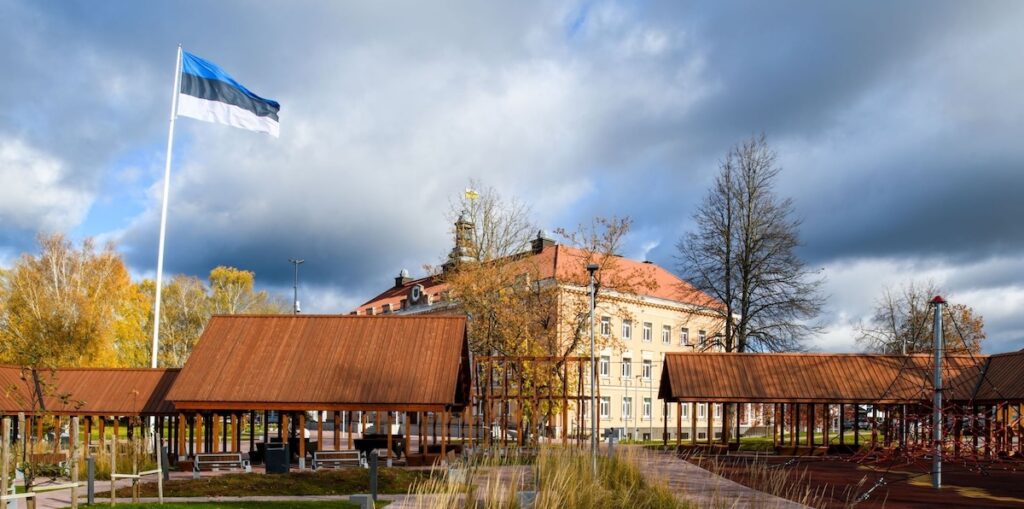 A 17-square-metre Estonian flag flies in Otepää’s central square on the country’s tallest flagpole, 20 metres high.
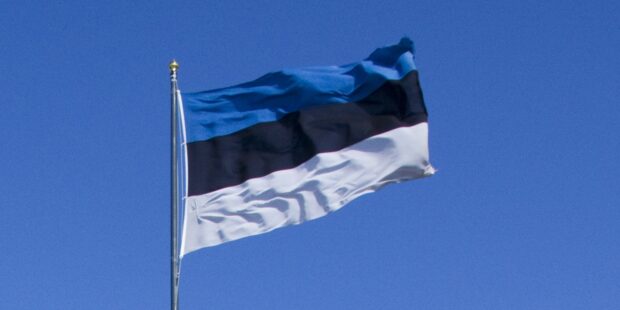
Alongside the national anthem and coat of arms, Estonia’s state symbol since 1918 has been the blue-black-white tricolour flag. Flag Day is celebrated on 4 June. Although the date is not tied to the founding of the state itself, it is rooted in the rise of national consciousness in the late 19th century, and the symbolism of the struggle for freedom.
In 1881, the University of Tartu was still largely a German-language institution, even though it belonged administratively to the Russian Empire. A group of Estonian-speaking students sought to establish a student fraternity called Vironia, whose colours would represent ideological loyalty and national ideals: blue for the sky and sea, black for the soil and the traditional black coat of peasants, and white for virtue and striving toward freedom.
Due to administrative resistance, the students instead formed a legal workaround: the Estonian Students Society, or Eesti Üliõpilaste Selts. In spring 1884, in Põltsamaa, they commissioned a flag made from silk in the Vironian colours. It was consecrated on 4 June 1884 in the parish house of Otepää, which is why this date later became Estonia’s Flag Day.
The original flag still exists today and is exhibited at the Estonian National Museum, or ERM, where visitors can learn about its history, including its decades-long concealment during the Soviet occupation. An in-depth English-language article on its history is also available via ERR.
Today, variations of the Estonian flag exist for official use by the President and the Navy, both featuring the national coat of arms with three lions. The presidential flag additionally includes a wreath of oak leaves surrounding the emblem.
The raising of the flag has not always gone entirely smoothly. On several occasions, it has been hoisted upside down, appearing as white-black-blue, such as during the 1992 Barcelona Olympics medal ceremony for cycling champion Erika Salumäe, at a youth football tournament in Sochi in 2013, and even briefly at Brussels’ flag square earlier this year.
The flag is also ceremonially raised atop Tallinn’s Long Hermann Tower at sunrise, or by law no later than 8:00, accompanied by the national anthem “Mu isamaa, mu õnn ja rõõm”. At sunset, or no later than 22:00, it is lowered to the song “Mu isamaa on minu arm”. If the flag is kept flying overnight, it must be illuminated. The only exception is the night between Midsummer’s Eve on 23 June, and Midsummer Day on 24 June, when illumination is not required.
Interestingly, in the 1920s, streets in Narva near today’s Fama shopping centre and Inger Hotel were named Blue, Black, and White Streets. These were renamed during the Soviet occupation, but one of them still exists today as Lavretsov Street.
To learn more about this and similar topicsblue-black-white Estonian Flag Estonian Flag Day Otepää Pikk Hermann Tower tricolour