“Our Erika” Is a Film Where Nostalgia Meets Triumph
Text and photos Stewart Johnson
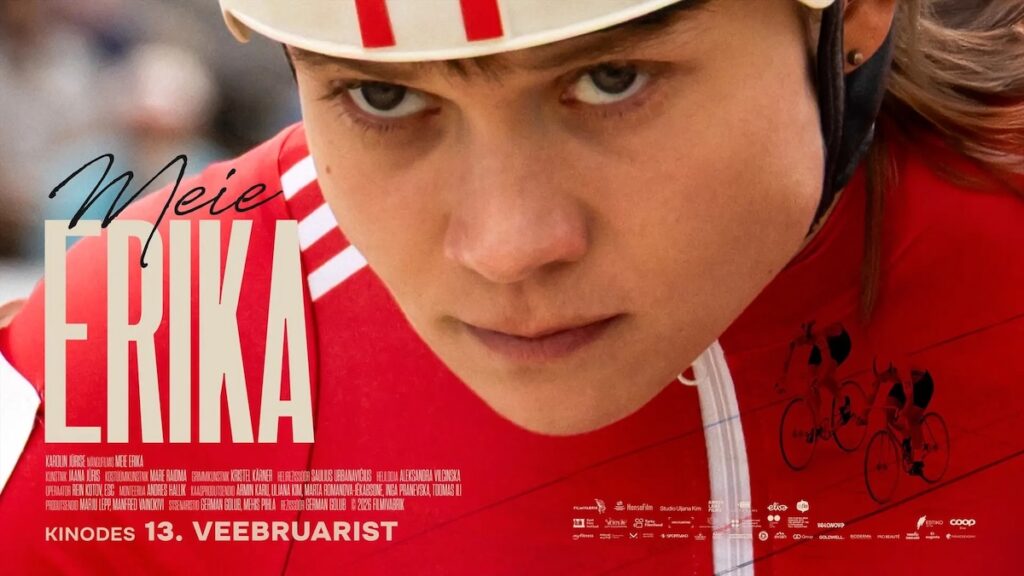
Estonian films all too often try to focus on too many things, or focus too much on only one thing. Director German Golub’s film “Our Erika” is this rare gem of Estonian cinema that has a lot to unpack, and yet somehow manages to balance everything almost perfectly. This biopic about Erika Salumäe, the first Estonian athlete to win Olympic gold after the country’s independence was restored in 1991, accurately depicts the nostalgia—and horror—of life during the Soviet occupation, and overcoming personal demons. These demons of course can be both inside your mind, and all around you.
Karolin Jürise is a young actress whose depth allows her to accurately portray Erika both as a 16-year-old, and as a cyclist and Olympic gold medalist a full decade older. Her character is a product of the Soviet system, a broken home, orphanages, and reform school. Identified as a potential athlete at an early age due to her physical prowess, the film shows how Erika, who is understandably a troubled child, comes of age, as well as rage.
Stanislav Solovjov is an abusive, Russian-speaking coach portrayed by Rodion Kuzmin of Latvia. His is the character audiences love to hate, as he is introduced as the charming guy who can take you to the top, but wants you to cheat along the way. Erika’s core traits begin to dominate her persona thanks to her dishonest coach, as she wants to do things the right way. The conflict between the two, regardless of how accurate it might have been in real life, is easily predictable in the film, yet satisfyingly so.
What makes “Our Erika” such an enjoyable film is the combination of good acting, and sets and cinematography. Largely filmed on location in various places in Estonia, audiences get an astonishingly precise idea of what Soviet-era life was like in the early 1980s. That is, if it were always summer, and if you lived among the pine forests and rolling hills of Southern Estonia. But, that is where Erika grew up. Every home at that time had at least one room with unpainted wooden panels, and there was always a clock ticking away the time.
Life in summer will always seem cozy if you live in the shade of a sunny forest. Soup was the plat du jour, and if you performed well for your country, you were rewarded with “meat and potatoes”, as stated in the film, to further improve your performance. This is one of the horrors depicted in the film—food as a weapon—yet not too much time is spent on it. A balanced diet for a balanced film. It is my belief that all Estonians under the age of 30 should see “Our Erika”, to better appreciate where they come from during today’s age of craft burgers delivered to your doorstep, and avocados on everything instead of dill.
Without giving any spoilers, the rest of the film shows how Erika overcomes her demons and other demons, which audiences already know.
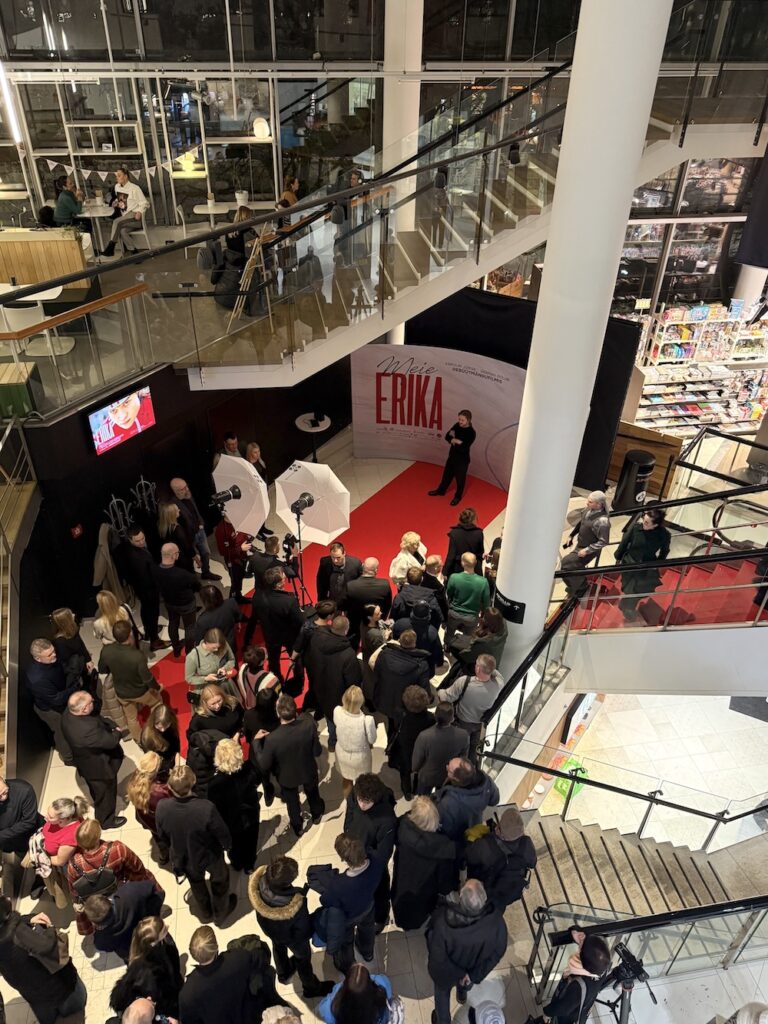
Now for the fun part of the review: I was invited to the premiere, because I have a small role with dialogue in the film. Two actually, but we’ll talk about that later. This wasn’t my first movie premiere, but it was the first where the photo wall was located at the bottom of an escalator, in the Solaris shopping mall in Tallinn. Usually there is some sort of direction at these sorts of events, telling you where to go if you’re cast and crew. Not at this premiere. As people lined up to have their photos taken, dozens more lined up waiting for their chance to squeeze by and go up the escalator to the cinema. It was a bit chaotic, in other words.
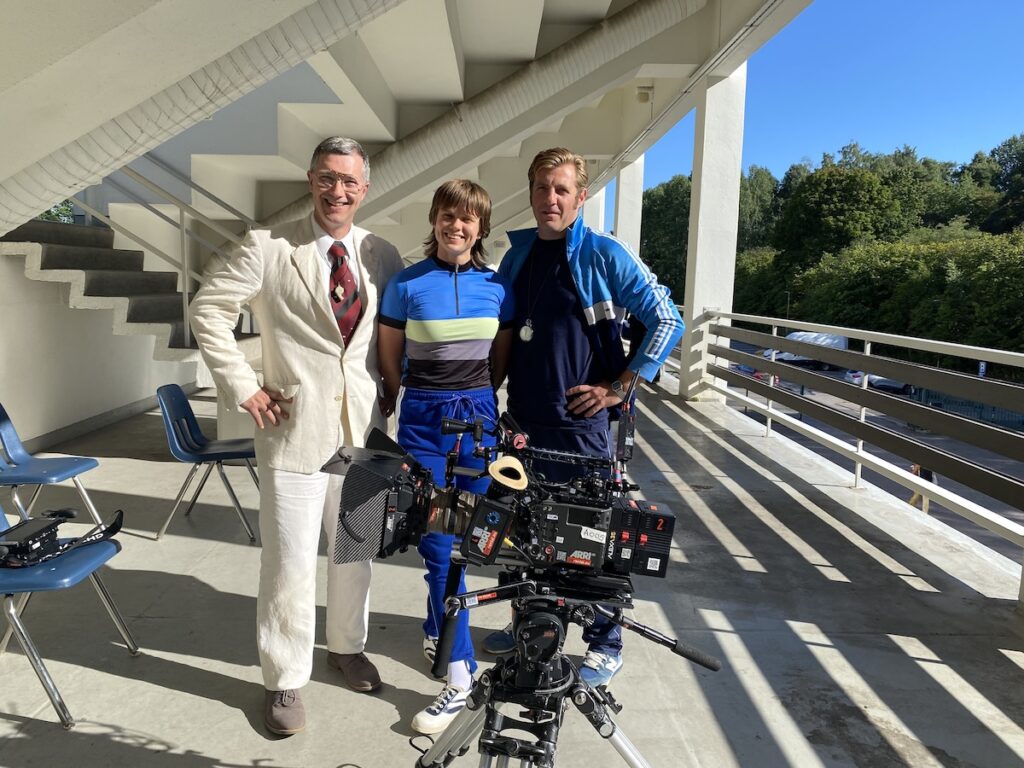
The set was not at all chaotic, however. Fully staffed and very professionally run by Filmivabrik OÜ, I arrived on set in Helsinki to play the role of a Canadian judge in 1983 Edmonton. Throughout the morning backstage, I kept noticing a woman wearing a cycling outfit identical to Karolin’s, but there was something odd about her. Distant. She kept to herself, and didn’t interact with anyone. She was sort of funny-looking as well, but I never got close enough to figure out what exactly was so unusual about her.
Later on the set of the Helsinki Velodrome, which was built in 1940 for the Olympics that were cancelled because of the war, but later used for the 1952 Helsinki Olympics, I saw this perplexing woman again, this time on a bicycle. Between takes, she crashed, and didn’t get up. I happened to be one of the closest people, so I ran to her. She began moving, and I asked if she was alright, but when she looked at me, her jaw was hanging from her face! Momentarily shocked, I didn’t initially notice that she was able to reply with perfect pronunciation that she was in fact ok, despite the hanging jaw.
A makeup artist approached and reattached her jaw, and the woman stood up, otherwise uninjured. She was the stunt double for Karolin, wearing an expensive mask. I still laugh at this story today.
In the second scene I was in, my character has a brief dialogue with Erika. After a few takes, my work on set wrapped, and I had a moment to talk with Karolin and Rodion. “You’re really good,” I told Karolin. “Are you a professional actress?” Initially stunned, she saw the laughter in my eyes, and started cracking up. And the cast really were professional actors! That’s likely why they cut the second scene I was in.
To learn more about this and similar topicsEstonian Film Estonian Movie Film Movie Our Erika