Estonian Culture Leans on the Old When Creating the New
Photo Andrei Chertkov
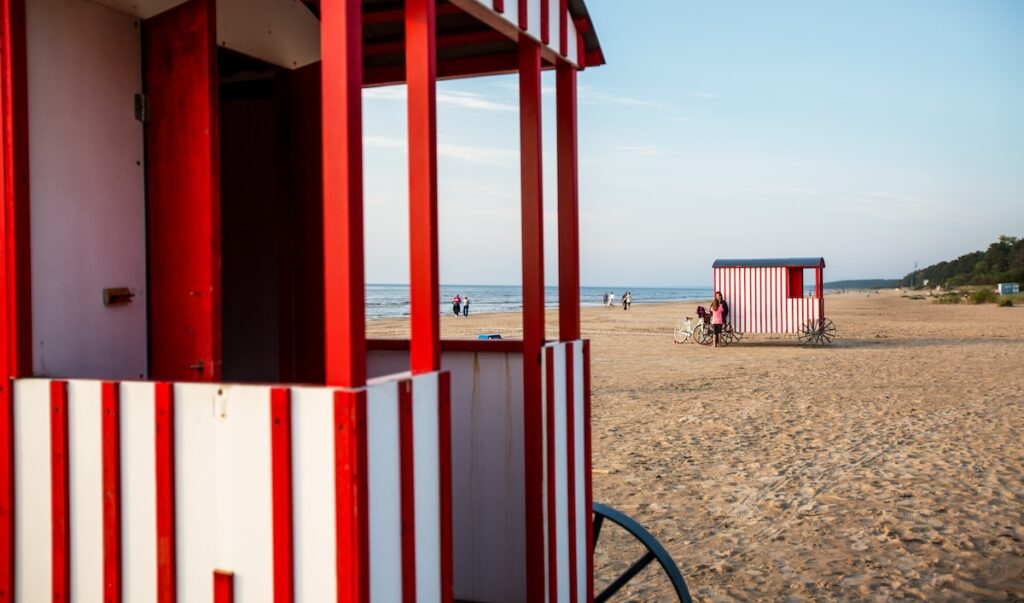 I imagine horse-drawn bathing carriages rolling to the water’s edge, with gentlemen leaping into the sea in their body-covering swimsuits, and shy ladies dipping in with grace.

Ville Hytönen, writer and chair of the Finnish Writers Union,
living in Suurupi, Harku, Estonia.
It’s a hot spring day on the Nordic Riviera. The pavilion of Meretare gleams like a golden dream palace on the beach of Narva-Jõesuu. Upon entering, the solid lacquered wooden tables and Art Deco chairs from the first Republic of Estonia invite me to sit, so I do—ordering mineral water and coffee. I look out at the shallow sea, and the crouching and running figures along the shoreline, like a scene from an old play.
I try to imagine myself in Estonia before independence—in this spa region by the eastern border, whose history began in 1873 when the fishing village of Hungerburg started transforming into a holiday destination for the aristocracy of St Petersburg.
In the late 19th century, Narva’s mayor Adolf Theodor Hahn developed Narva-Jõesuu by improving roads and building luxurious cottages for the rich of tsarist Russia. The promotional campaign succeeded, drawing in residents and guesthouse entrepreneurs alike—such as the renowned Dr Zaltsman, with his own sanatorium.
Through the freshly washed windows of the restaurant, I imagine horse-drawn bathing carriages popular with the gentry being rolled down to the water’s edge, where gentlemen in fashionably full-body swimsuits leap into the sea, or shy ladies dip their toes. I can smell the sun-warmed pine needles swaying in the coastal breeze, and the brackish scent of the shallow Baltic water.
During the early Republic of Estonia, Narva-Jõesuu continued to flourish. Boarding houses, the grand Villa Irene known for its spired towers, the elegant wooden Mon Repos, and the lace-trimmed mansion of patron Zinovjev all lived their golden age. Distinguished guests, including Finland’s President Svinhufvud, vacationed at the Hotel Villa Capriccio. In the Kaivohuone salon, orchestral music played, and in the early evening, people strolled in their summer suits down Hahn’s Road toward the green space known as Valoisa Park.
I don’t know whether this fantasy soaked in old-world aesthetics comes from the first warm day of the season or from the fact that I have undeniably entered middle age. Dreaming of the past now feels like dreaming of the future.
In Estonia, one often sees intergenerational nostalgia for the time of the first republic. Kursaals, manors, and old buildings are restored. Young men wear bowties at important events. The era before the ethically and aesthetically grim Soviet times emerges through modern architectural references, museum exhibitions, and period films.
And as often happens when ethics and aesthetics walk hand in hand, much from a hundred years ago feels familiar. Even then, Estonia was a small, emerging nation that understood its uniqueness through a blend of provincial character and international perspective.
Education was respected. Proper manners were valued. Honesty and entrepreneurship had their place. The overall tone was both bourgeois and peasant-like—perhaps due to the strong work ethic and national ethos. For a brief moment, hard-working Estonia was economically more prosperous than its Finnish brother nation.
Something of that spirit persists today. Estonians are hungry to continue building their nation. Year by year, society shifts closer to the Nordic model: taxes are raised, education is improved. But perhaps the most significant difference from Finland is how culture is perceived—in Estonia, it’s considered essential for survival. While a Finnish finance minister may declare art a luxury, an Estonian sees it as an existential issue.
As I sit here in Meretare, I imagine that music will play again this evening in Valoisa Park. Perhaps some youth will tie on a bowtie before dashing to the beach with a companion. Bringing history into the present is not anachronistic—it’s intergenerational memory, a form of cultural reverence.
I’m waiting for a friend. Perhaps it’s Jaan Poska from Tallinn (1866–1920), or Narva’s mayor Adolf Theodor Hahn (1832–1914), or someone more recently met. What matters most is that we can sit together over mineral water and talk about these things—recalling the past and dreaming of what’s to come, properly dressed, bowties and all. Perhaps even discussing new books.
To learn more about this and similar topicsBeach Coast Estonian beach Estonian Coast Estonian history Narva-Jõesuu


![Estonia: Powered by Song [Review]](https://balticguide.ee/wp-content/uploads/2015/06/Helen-4-620x310.jpg)