Estonians Have Always Travelled
Text Antti Sarasmo

Illustration The Baltic Guide archive / Hannu Lukkarinen
When Estonia regained independence in 1991, a wave of foreign tourists began arriving in the country. However, this was not the beginning of Estonian tourism, it was simply the start of a new era of travel.
Tourism, meaning travelling for pleasure, is a relatively modern phenomenon. People did travel during the Middle Ages, but there was always a specific reason. Pilgrimages were journeys made even by ordinary people. They followed pilgrimage routes, demonstrated their devotion, and at the same time saw foreign lands.
Tallinn was a Hanseatic city, and during the sailing season shipping on the Baltic Sea was active. From Tallinn, people travelled to other Hanseatic cities to establish business contacts. A merchant’s son might leave as an apprentice with his father’s business associate, or someone might travel to court the daughter of a merchant in another city. Within the interconnected Hanseatic world, people moved frequently, and there was always somewhere to go.
The spa beckons
Travelling purely for leisure began to increase in the 19th century. At first, these were health journeys. As we know from films and television series depicting the era, the upper classes ate heavily, perhaps even too heavily. Health trips were therefore needed.
Across Central Europe, spa towns developed around mineral water springs. The upper classes strolled through parks, drank mineral water and ate lightly. It certainly must have improved their well-being.
Estonia did not have mineral water springs, but it did have something else: a coastline. Sea bathing, actually immersing oneself in seawater, was only for the bravest. Even its health benefits were questioned: perhaps cold seawater was too harsh a treatment? The problem was solved by offering heated seawater baths in bathtubs.
Life among the urban upper and upper-middle classes at the end of the 19th century was rather passive. People did not exercise, they did not do physical labour, and servants took care of daily tasks. Holidays provided an opportunity for movement, as walking was an essential part of the spa experience. If nothing else, guests could walk around the park several times.
Other activities included different types of baths, such as heated seawater baths, and evening concerts. The menu was designed by the spa doctor and was considered “light” by the standards of the era. Health holidays lasted a long time: a month or a month and a half was considered an appropriate treatment period.
At spas, people met other guests from their own social circles, formed connections and spent time together. Some even became active enough to play bowling or go swimming.
In Tallinn, a spa facility was built on the Kadriorg coast in 1813, and in 1840 a proper seaside spa was established with restaurants and a library. A library was needed because after walking, guests would sit in the park and read.
Travelling from St Petersburg to Tallinn was easy by ship, but the major influx began when the railway connection to St Petersburg opened. A horse-drawn tramway was even built between Kadriorg and the city centre, today’s Old Town. The carriage ran smoothly on rails, and one horse was enough to pull several passengers.
Later, when a new railway was built from St Petersburg to Crimea in the 1880s, holidaymakers began heading south.
Although Estonia had no mineral springs—Värska was not yet known as a source—it did have therapeutic mud. Warm mud baths became popular, and the spa towns could be reached conveniently by coastal ships. Haapsalu and Kuressaare became the most famous mud-bath destinations.
The first sanatorium opened in Haapsalu in 1825, and one opened in Kuressaare in 1860. In Pärnu, spa activity only really began after the city took control and completely renovated the old spa in 1889.
Haapsalu became so famous that even the emperor visited for holidays after the railway connection to St Petersburg opened in 1905. Haapsalu’s covered railway platform is unusually long for a city of its size because passengers arriving on the imperial summer train needed immediate protection from rain and sun after stepping out of every carriage.
At the height of Haapsalu’s popularity in the early 20th century, as many as 8000 spa guests visited the city during a single summer.
Domestic tourism and foreign visitors
After Estonia gained independence and the War of Independence ended, tourism began to be organised. The first goal was to encourage domestic tourism and introduce Estonians to their own country.
Immediately after the war, in 1920, university student Johannes Maide travelled around Estonia by canoe and wrote travel letters for newspapers, later turning them into a book.
A little later, in 1924, the publishing house of the sports organisation Kalev published a book called “Rändur Eestis”, or “Traveller in Estonia”. Nature tourism and discovering Estonia’s landscapes became the foundation of domestic travel.
Later, in the 1930s, attractions were built and renovated to create suitable destinations for visitors.
The spa towns remained popular, even though the Russian visitors from St Petersburg had disappeared. Pärnu became the summer destination for senior civil servants and business leaders. It was the place for the elite, and the luxurious Rannahotell, or Beach Hotel, was built to serve them in 1937.
Cultural figures, writers and actors spent their summers in Haapsalu. The city’s summer cultural life during the interwar period was lively and high-quality.
Ordinary civil servants and teachers, meanwhile, favoured the Aegviidu holiday home, which had a good railway connection from Tallinn and was surrounded by large forests.
Many city residents spent their summers in the countryside with relatives, just as people did in Finland at the time.
Foreign tourists also began arriving. Pärnu’s attraction was its ferry connection to Sweden, while Tallinn had connections to Finland.
For example, in 1926, after normal conditions had returned, Estonia received 69,859 foreign tourists, of whom 4528 were from Finland. The peak year for tourism was 1936, when there were 160,110 tourists, including 12,221 Finns.
However, the largest number of foreign visitors came from neighbouring Latvia: from Riga and elsewhere in the country, 52,738 in 1926 and 127,056 in 1936.
Restrictions during the Soviet era
In the post-war Cold War world, every Western traveller in the Soviet Union was considered a potential spy. Western tourists had their own travel agencies—Intourist and Sputnik for young people—as well as their own hotels and listening rooms in those hotels. Western visitors were carefully looked after, and were never left completely on their own.
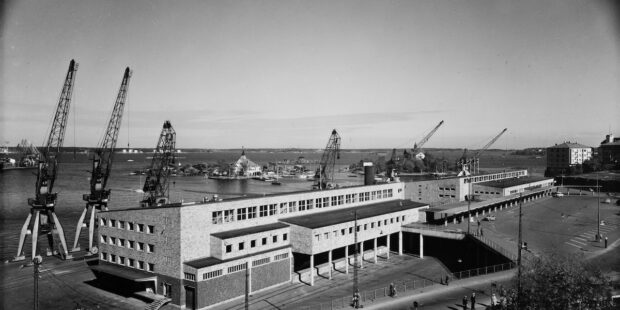
The ferry route between Helsinki and Tallinn opened in 1963, and the ship Georg Ots joined the route in 1980. The Viru Hotel opened in 1972.
As tourist numbers increased, surveillance could no longer be carried out through personal supervision alone. This was the beginning of the era of stories about “Soviet tourism”.
At the same time, Estonians’ holidays were organised through workplaces. Trade unions distributed “tuusikud”, holiday vouchers or packages. A person could receive a package holiday, for example, at a Pärnu spa.
There were not enough holiday packages for everyone, so distribution was justified using “objective socialist” principles.
Large industrial organisations had their own holiday villages where they sent their employees. Holiday opportunities could also be obtained through various public organisations.
Foreign travel meant travelling within the Soviet Union. Better-performing workers could visit other socialist countries, and the most trusted citizens could even travel to capitalist countries such as Finland.
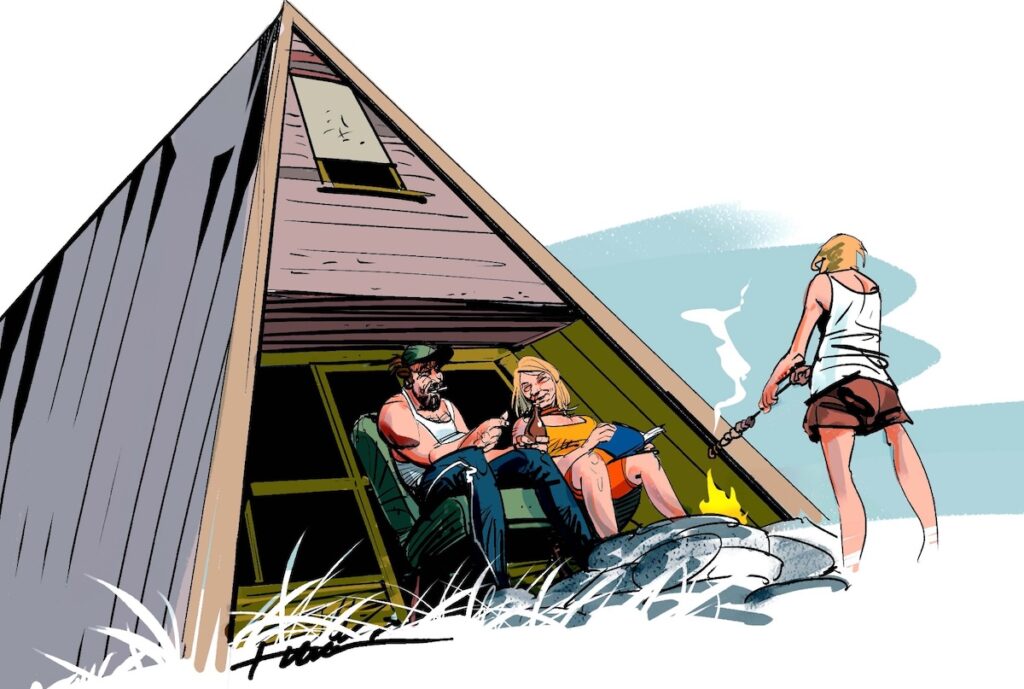
Those who were not lucky enough to receive a holiday package could spend their holidays at campsites, living in tents throughout the summer.
There were also villa cooperatives. People could build their own standardised holiday homes in controlled areas resembling allotment gardens.
With Estonia’s restoration of independence, tourism became free and normalised. One international curiosity is the special relationship between Tallinn and Helsinki: today, people simply visit the neighbouring country’s capital for a day trip.
That is the new tourism.
To learn more about this and similar topicsHaapsalu holiday village Pärnu Spas Tourism villa areas