How to Recognise a Good Tour Guide
Text Stewart Johnson
Photo Anddrei Chertkov
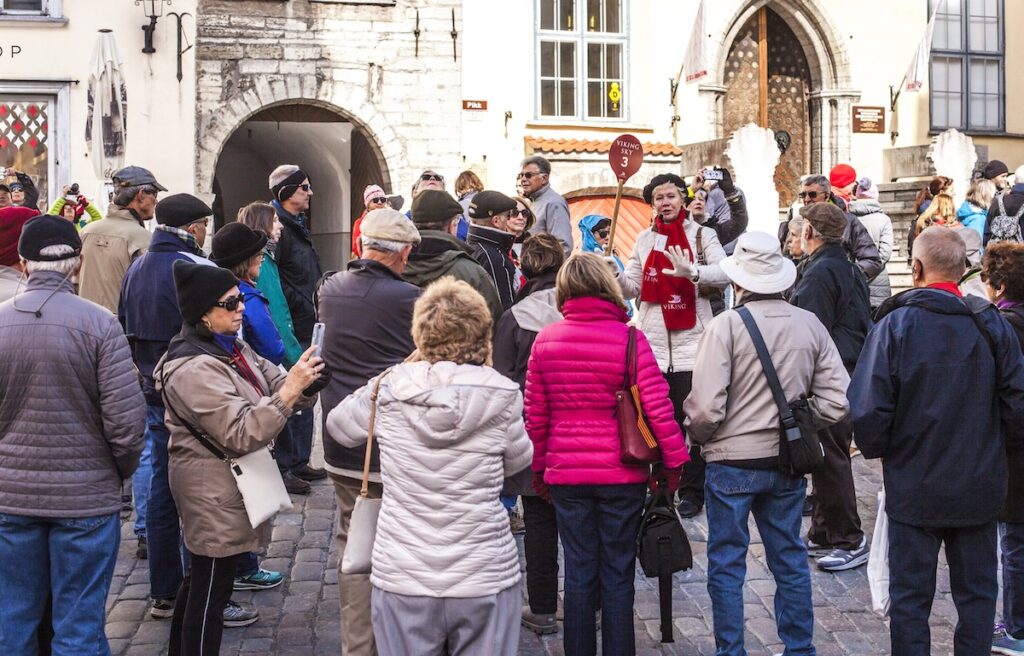
Guided tours in Tallinn can be a wonderful way to learn about the deep cultural, and architectural, history of this fabulous city. If you have learned a lot of information on your tour, but you haven’t drowned in information, you’ve had a good tour guide. This guide helps you recognise if you don’t have a good tour guide, however, and fun ways to deal with it.
If the tour guide doesn’t know something
No one knows everything. It’s just not possible. But a good tour guide will know more or less all the information tourists typically want to know. They’ve researched it, they’ve learned, and they’ve updated their narrative. For example if you start your tour at Tallinn’s famous Viru Gate, the guide will be able to tell you that it was built in the 14th century, and was just one of eight main gates to the medieval old town, and was part of a very broad defensive network. Other parts of this particular gate were demolished in the late 19th century in an effort to modernise this historic part of Tallinn.
But if a tour guide doesn’t know this, they should admit they don’t know, and research the answer to your question after the tour, sending the answer via email to those interested. A bad tour guide will make something up. For example they might say the gate was originally built “a long time ago” and was inspired by Walt Disney’s Magic Kingdom, even though the latter was built centuries later. If this happens, then it is safe to assume this tour guide is speaking to you in their native English language, and you can have some fun by asking them how long they have lived in Estonia.
If the tour guide doesn’t have basic necessities
A good tour guide is a leader, responsible for their flock throughout the tour. They’ll have an extra bottle of water, a map, a first-aid kit, and they’ll certainly have knowledge of where the nearest toilet is. For example if you’re on Tallinn’s famous Town Hall Square, or Raekoja plats, you’re likely admiring the Town Hall building, which was completed in 1404, and is the oldest surviving Gothic town hall in Northern Europe.
But you had one too many drinks on the ferry, and you need to ask where the nearest toilet is. If the tour guide answers right away, then all is good. But if they say they don’t know, “You can try in that bar over there!”, then politely thank them for the suggestion, go inside, do your business, but then order a drink and make the tour guide wait. The rest of the group will appreciate you punishing the tour guide for their lack of preparation.
If the tour guide is disrespectful to locals
This one is a two-way street of course, meaning you as the visitor should respect local culture and practices. One important way to do this is to never refer to Estonia as a “post-Soviet” country. The occupation ended 35 years ago, and would be somewhat akin to referring to Finland as a “post-Swedish” country. Obviously the history and amount of time are very different, but you get the idea.
But if you’re admiring the incredible view of medieval Tallinn from the Kohtuotsa viewing platform atop Toompea Hill, and you ask about prices in one of the many jewelers in the areas specialising in amber, pay attention to how the tour guide answers. If they recommend one place, or don’t recommend another, they’re likely getting kickbacks. This is not really allowed in Tallinn. So here’s what you do: force the guide into the shop they did not recommend, and tell the staff, “This tour guide said you’re not a good shop.” The resultant complaint from the management to the tour operator will fix the problem for future tourists.
A good tour guide however, if you ask about amber jewelry, will inform you that while the goods may indeed be designed and produced in Estonia, the amber itself is from further south. Estonia does not have large deposits of amber, so the sale of this 50 million-year old fossilised tree sap is a tiny bit misleading. If later you can’t resist the temptation to buy one of these beautifully crafted pieces, even though the amber is not local, you can instead have fun with the vendor. Ask if the amber is Estonian. If they say no, and explain where it’s from, you’ve got an honest purchase right there. But if they say it is Estonian in origin, then mention how you’ve had your heart set on purchasing a piece of amber with a fossilised Arctic scorpion trapped inside. When the vendor reacts with a ridiculous face, quickly take a photo of it for a few laughs once you get back home.
If the tour guide asks for a tip
Your tour is concluding in the Danish King’s Garden, right next to Toompea Hill, and the fully intact medieval city wall. The tour guide correctly informs you that yes, this is the place where Denmark’s flag, the Dannebrog, supposedly fell from the sky in 1219 during a battle with locals in an uprising, and that yes, the flags of Sweden, Iceland, Norway, and even Finland, are also inspired by this flag. Then the tour guide thanks you for your time and attention, and proceeds to ask you for a tip.
First of all, you’ve already paid for the tour. Tipping is not expected in Estonia unless you get excellent service, above and beyond any expectation, and even then it’s optional. A good tour guide will not ask for a tip, but they likely wouldn’t refuse one, either. But a bad tour guide might ask you for a tip. So here’s what you do: always carry a handful of Finnish markka with you. They just might come in handy with a bad tour guide.
To learn more about this and similar topicsEstonian Culture Estonian Tourism Old town Toompea tour guide Tourism Tourist Viru Gate