The Baltic Way—A Human Chain
Text Antti Sarasmo

Photo The Baltic Guide archive/Hannu Lukkarinen
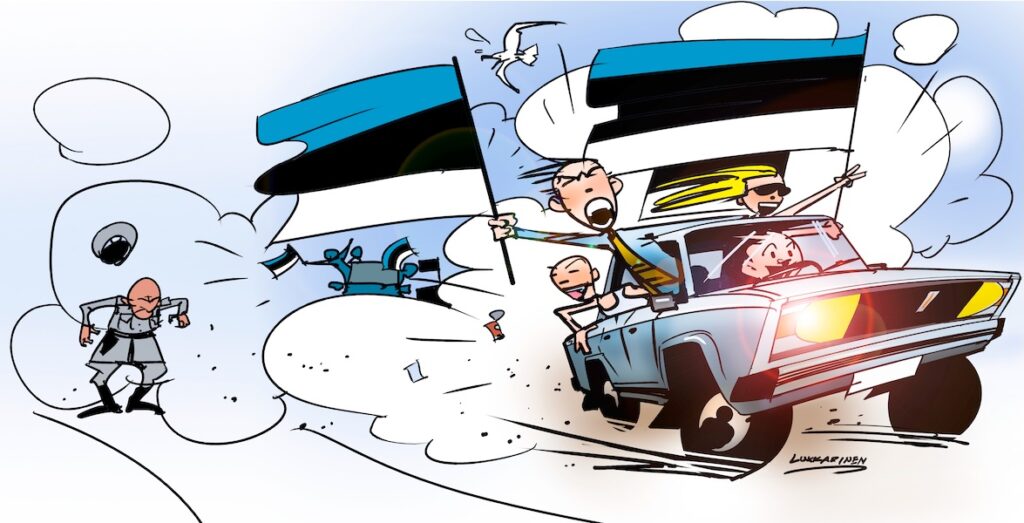
The year 1989 was quite a remarkable one. The Berlin Wall fell, and communist political systems collapsed across Eastern Europe. The Baltic countries were still part of the Soviet Union, but unrest was growing there as well.
When the clock struck seven in the evening, a message began to travel along the chain: “Freedom!” the crowd shouted in three languages. More than two million people formed a human chain stretching from Tallinn’s Pikk Hermann Tower to Gediminas Tower in Vilnius.
The distance was 620 kilometres, and the chain was unbroken. In many places the chain was several people thick so that everyone who wanted to could take part. The Baltic peoples were sending a message to the world—and to Moscow—that they wanted to be free and independent.
The propaganda claim about the 1940 elections
Political activity aimed at restoring independence in the Baltic States had already begun in 1987–1988. In the summer of 1988, the “Singing Revolution” started in Estonia, and similar developments were under way in Latvia and Lithuania.
Moscow’s main argument against Baltic independence efforts was that the countries had voluntarily joined the Soviet Union. This claim was repeated in every possible situation and constantly invoked. According to the Soviet Constitution, republics that had joined voluntarily could only leave if all other Soviet republics approved their exit. In the Baltic States, this approval was seen as unrealistic.
The decisive elections had been held in June 1940. The Soviet Union had established military bases in the Baltic countries in autumn 1939. In late spring 1940, the USSR demanded the resignation of the “anti-Soviet” governments and the transfer of power to the people. When the Red Army marched into Estonia, Latvia, and Lithuania and replaced their governments, France was engaged in its decisive battles, and the world’s attention was focused there.
Immediately afterwards, new elections were organised in which only approved political organisations could nominate candidates. In all three republics, the communists received an overwhelming majority of votes, and full parliamentary representation. These new parliaments then humbly requested admission to the Soviet Union—and the applications were naturally approved.
It was impossible to advance the cause of independence simply by telling the election-riggers that they had falsified the elections, and the results. Disputing the elections was as much of a political dead end as relying on the Soviet Constitution’s theoretical provision for secession.
The Molotov–Ribbentrop Pact
In 1939, on the eve of the Second World War, Nazi Germany and the Soviet Union agreed on mutual cooperation and friendship. The pact, named after their respective foreign ministers, included a secret additional protocol dividing spheres of influence.
The Soviet Union received areas of Poland, the Baltic States, and Finland as its sphere of influence. Germany would not interfere with Soviet actions in those regions, and the Soviets would likewise stay out of the German sphere.
The existence of the secret protocol was known in autumn 1939, but few had seen it. Germany’s copy was found on microfilm at the end of the war, and ended up in American hands. The Soviet copy was searched for in archives for decades, and officially the USSR claimed it had never existed.
Copies of the protocol held in US archives were even circulated in the Baltic States. The newspaper Rahva Hääl published the original text and a translation on 10 August 1988. The print run was large: about 200,000 copies of that issue were sold. Now the protocol could no longer be denied; it was stored in so many Estonian households that no state security service could hope to collect all copies.
If Lithuania, Latvia, and Estonia had already been promised to the Soviet Union, how could they have joined it voluntarily? According to the division of spheres of influence in the protocol, it was clear that the countries had been conquered. This was the argument the independence movements needed.
The 50th anniversary
By fortunate coincidence, 23 August 1989 marked 50 years since the signing of the Molotov–Ribbentrop Pact. In the Soviet Union, the pact was something best forgotten, but the world had not forgotten. In the Baltics, it was decided to take action that would force the Kremlin to react to the secret protocol. They chose to organise a spectacular demonstration.
At the time, one of Estonia’s most visible political leaders was Edgar Savisaar. He proposed the idea of a human chain, and persuaded the Lithuanians and Latvians to join the plan.
Time was short, and the task immense. In Estonia, responsibility fell to the Popular Front, Rahvarinne. Another significant independence movement was the Congress of Estonia, but its membership consisted of individuals. In the Popular Front, membership was collective—for example, an entire factory workforce would belong to a local section, and through that, to the Popular Front. Now people were needed. About 400,000 people took part in the Estonian section of the chain. Since the Estonian population was about one million, nearly everyone who could participate was needed.
The route was planned so that thousands of people could be transported there. In Estonia, the chain ran from Tallinn through Rapla, and Viljandi to Karksi-Nuia, and from there to Latvia. Central Estonia could be reached from both east and west, and the chosen road had sufficient cross-connections.
The route was divided into manageable sections, each inspected on site. “…200 metres from the crossroads to the big spruce by the house. Next, from the big spruce 100 metres to the speed limit sign…” The number of people and the required backups were calculated precisely for each segment.
Local sections chose the segments they knew they could fill. Once it was known who was going where, transportation planning began. Participants arranged their own buses and vehicles, but assembling 400,000 people along one road required instructions, schedules, and parking space. That evening, traffic in Estonia was heavy.
Public radio in all three countries began broadcasting uninterrupted live coverage at 17:00. Instructions were given via radio regarding traffic jams or sparsely filled parts of the chain. People had been asked to bring radios, and these can be seen in every roadside photograph. An ambulance was stationed about every 10 kilometres, and each kilometre had a steward’s post. At intersections, there were traffic controllers. Participants stood on the eastern side of the road so emergency vehicles could pass if needed. Nothing serious happened.
At seven o’clock on that August evening, the event began. The radios of the three countries started a joint broadcast. In Tallinn, a couple of short speeches were delivered, and a song composed for the chain—sung in three languages—was played. Then came the shout: “Freedom!” The cry travelled along the entire chain, switching from one language to another, and finally reached Vilnius. Candles were lit; people stood in the chain listening to the radio, speeches, and patriotic music.
The chain was dismantled by organising festive bonfires, or “kokkojuhla”, at suitable intervals in regional centres, where the now-unneeded placards were ceremonially burned. The celebrations began at nine and lasted as long as needed. They dispersed the crowds, and everyone returned home without problems.
A couple of million people met one another via radio waves, and many also along the roadside. Strangers shared, on that August evening, the dream of freedom and a free homeland.
The Baltic Way was a miracle.
To learn more about this and similar topicsBaltic Way Freedom Independence protest Soviet Union