Dining on Works of Art at a Michelin Restaurant
Text and photos Timo Huttunen
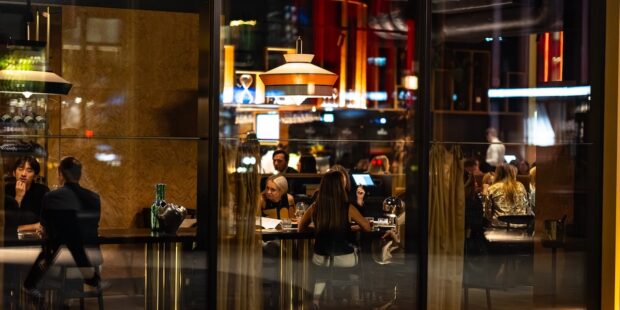
 The tables are set higher than the central kitchen, surrounding it like an amphitheatre.
German chef Matthias Diether began his culinary career in 1995. From 2016 he served as head chef at the Alexander restaurant at Pädaste Manor on the island of Muhu, as well as at Alexander Chef’s Table in Tallinn, until spring 2018. In August 2018 he opened 180° by Matthias Diether in the Noblessner marina.
The entrance to the red-brick waterside building is striking. Guests are first guided into a lounge centred around a live fire. Here, four small dishes are served—already offering a hint of the restaurant’s calibre.
The first room resembles a lobby bar, with soft sofas where guests enjoy their aperitifs.
From there one proceeds to the main dining room, where astonishing sea views open up. The kitchen forms the heart of the space, with the tables set higher and surrounding it like an amphitheatre.
There are only 35 covers. On this particular Saturday the restaurant was full, the clientele consisting of surprisingly ordinary people—many speaking Estonian.
The décor employs calm, muted tones: browns, beiges and greys are dominant, with crisp white tablecloths and long, dramatic curtains framing the windows.
Around half of the staff are Estonian; the rest come from across the world. There seemed to be more members of staff than there were guests.
In creating his dishes, Chef Diether is clearly fascinated by the “unholy” combination of meat and fish—blending them into a third dimension that is neither one nor the other. The flavour world is unpredictable, intriguing, balanced, and even addictive.
Some combinations make an immediate impression; others take a moment to be fully understood as the elements settle into harmony. This is sheer brilliance. Not a single dish disappointed, even when the flavour spectrum—such as in an octopus-pork dish—was as delicate and precarious as a tightrope walk.
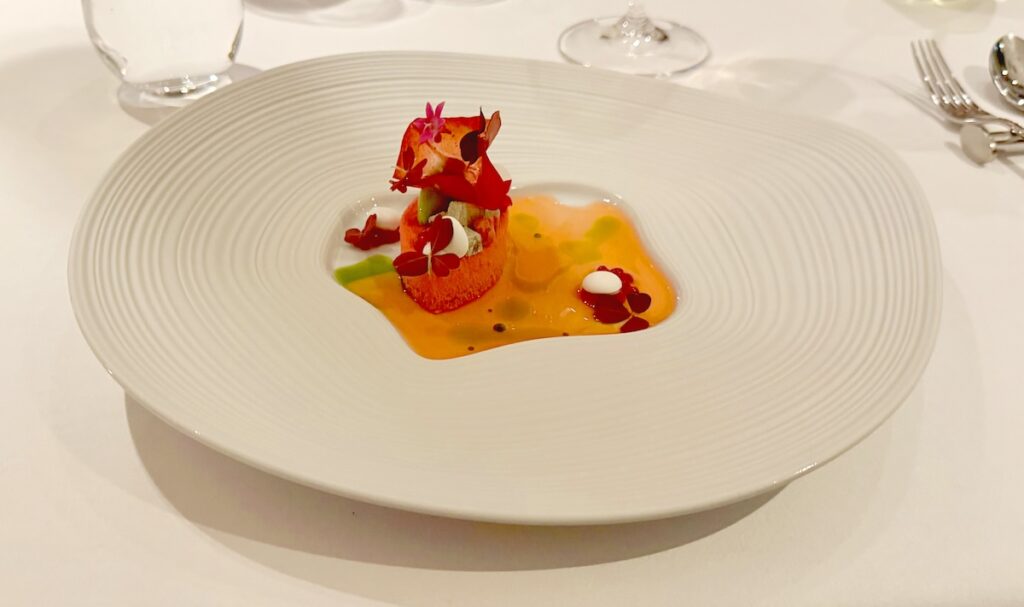
The dinner featured surprising pairings and dishes whose appearance was entirely deceptive.
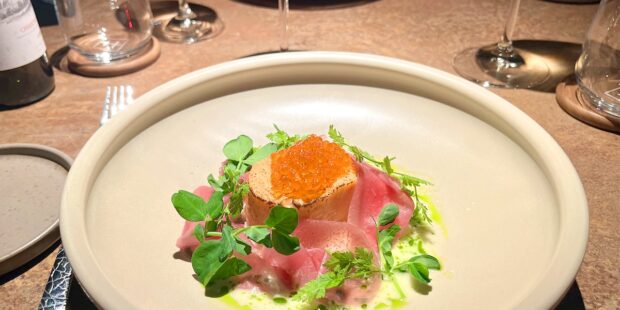
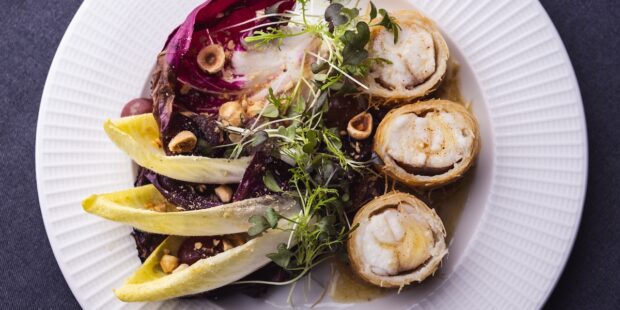
Veal head was combined with sea bass, though this was impossible to discern visually. Inside a cherry in the eel dish was, in fact, foie gras. Foie gras appears to be one of Diether’s favourite ingredients.
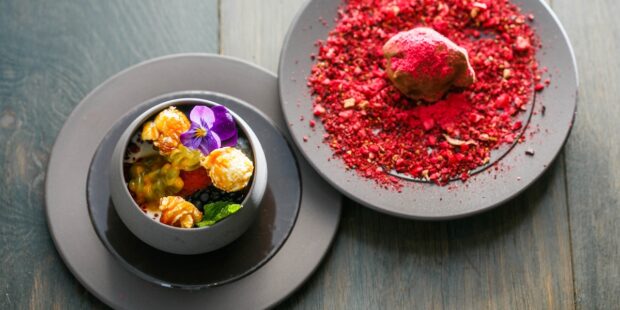
The guest is constantly challenged by appearance, texture, materials, colours and flavours. The visually striking dishes play with contrasts of texture and element, yet the flavours remain clean and the mouthfeel fascinating.
Each small dish is a work of art whose design, development and execution clearly demand immense time and remarkable craftsmanship. As one of our servers put it: “It is a shame that to enjoy the flavour, you have to break the artwork.”
Service, too, is of a level one seldom encounters. Four highly competent servers tended to our table, and everything ran with the precision of a German factory.
The only minor disturbance was the repeated questions: “Is everything all right?” and “Did you enjoy the dish?” It felt inadequate to answer, given that everything was better than all right, and the dishes were divine.
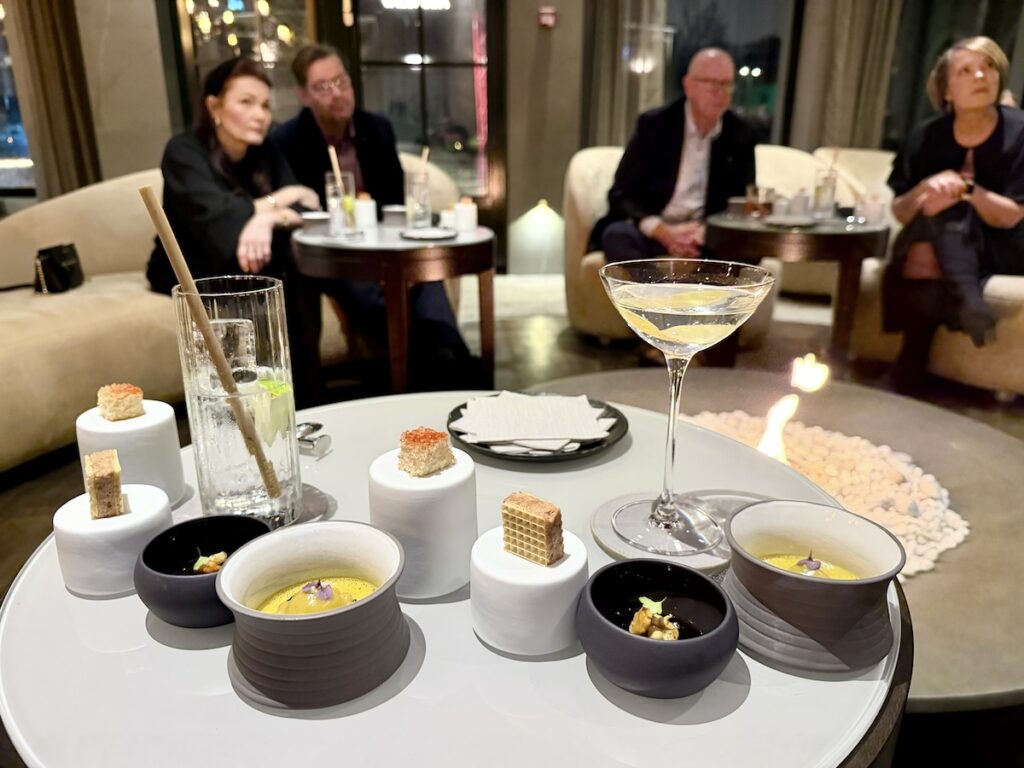
It is not even appropriate to speak of “presentation”, because the dishes are never what they appear to be. The entire meal feels like sitting at the centre of a magician’s performance.
Nor is it useful to attempt to describe the flavours in writing—the only real way is to experience them in situ. Suffice it to say that the lamb dish was among the most traditional, and that the dessert course consisted of three sweet dishes rather than one.
Some dishes reached true wow-level; others were steadier.
The sommelier’s wine pairings were unusual and even bold, sourced from across the world. The flavours of the dishes were amplified by each carefully chosen pairing.
It is a privilege to see and taste the fruits of such creative imagination. The staff bring the chef’s vision to life every day. The work is performed with unwavering consistency at an exceptionally high level, with each repeated dish appearing and tasting exactly the same.
Perhaps there are even slightly too many dishes and wines. Some guests’ concentration may falter, their senses overwhelmed by the symphony of flavours—much as in a large art museum, where the abundance of stimuli can obscure even the masterpieces.
Still, anyone who values culinary culture should experience a dinner of this calibre at least once in their life. Only then can one understand the standard against which all other dining experiences, past or future, must be measured.
180° raises dining to a new level—but not cheaply. Expect to devote at least four hours and €400–€600 per person for food and wine.
180° by Matthias Diether, Staapli 4, Noblessner Marina, Tallinn
Menu dishes and wines
- Chanterelle Variation
- Shellfish Ravioli—Spinach—Saffron
- 180 Degrees Foie Gras—Hazelnut
- Tomato Marshmallow
- Eel—Foie Gras—Cherry
Tim Hillock La Cosmica 2023, South Africa - Sea Bass—Artichoke—Veal Head Ragout
Oxer Wines Marko Gure Arbasoak 2024, Spain - Octopus—Pork Shank—Kimchi—Green Pea
Schloss Gobelsburg Ried Renner Grüner Veltliner 2021, Austria - Monkfish—Blue Prawn—Bisque
Venus La Universal Dido La Solució Rosa 2023, Spain - Lamb Duo—Caesar Salad—Potato
Umami Ronchi Cumaro Conero Riserva 2020, Italy - Pre-dessert
- Strawberry—Wood Sorrel—Yoghurt
Hattingley Valley Brut Rosé 2020, England - Petit Fours selection
To learn more about this and similar topics180 Degrees Food Matthias Diether Michelin Michelin restaurants Michelin two stars Estonia