Hiking Across Estonia on Foot
Text Mikko Virta
Photos Iti-Jantra Metsamaa, Toomas Erikso
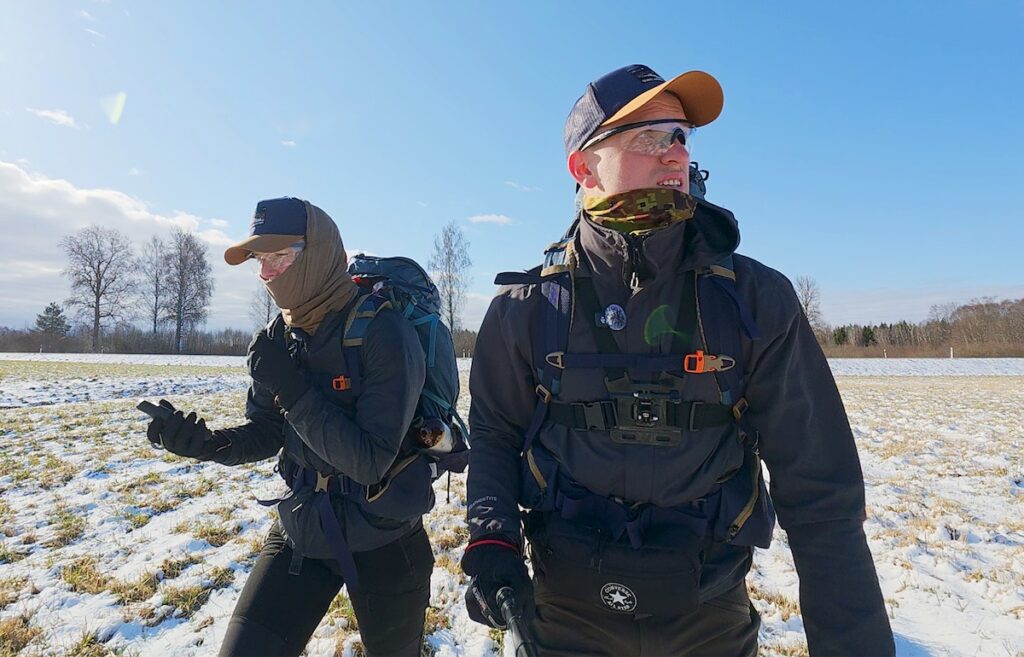 Iti-Jantra Metsamaa and Toomas Erikso crossed Estonia in spring 2025. The straight-line distance from the Latvian border to the Gulf of Finland coast was 176 kilometres.
What would you think of a hiking trip across the whole of Estonia? And doing it in a straight line—through bogs, fields, yards, and thickets?
That is exactly the kind of journey undertaken by Iti-Jantra Metsamaa and Toomas Erikso, who live in Kiviõli in Ida-Virumaa.
The idea for this unusual hike arose when Toomas Erikso saw a video online by the British GeoWizard, Tom Davies. The YouTube video, now viewed millions of times, shows him walking across Wales in a perfectly straight line through hedges and farmland.
“I have always enjoyed being in nature and going on adventures, and when I saw GeoWizard’s amazing video, I was really inspired. It would be fantastic to visit places you would never otherwise come across,” he says.
What exactly is straight-line hiking? According to Toomas Erikso, there are strict rules that must be followed.
“You must not deviate more than 25 metres from the pre-drawn straight line on the map. That earns you a platinum-level result. The absolute limit is 100 metres. If you have to deviate more than that, the attempt is disqualified.”
At first, the strict rules may sound restrictive, but according to Iti-Jantra Metsamaa, they are precisely what make the hike exciting and challenging.
“You never know what kind of obstacle awaits around the corner. If necessary, you just go straight through a spruce hedge.”
The couple’s first trip took place in spring 2024 on the island of Muhu, which they crossed in just a few hours. Although the distance was only 13 kilometres, the terrain made the journey demanding.
Next came Estonia’s largest islands—Saaremaa and Hiiumaa. The latter Iti-Jantra Metsamaa crossed alone, as Toomas had an injured hand.
“That was the first and last time I’ll do this kind of hike in summer. The vegetation and all kinds of insects made it quite challenging,” she says.
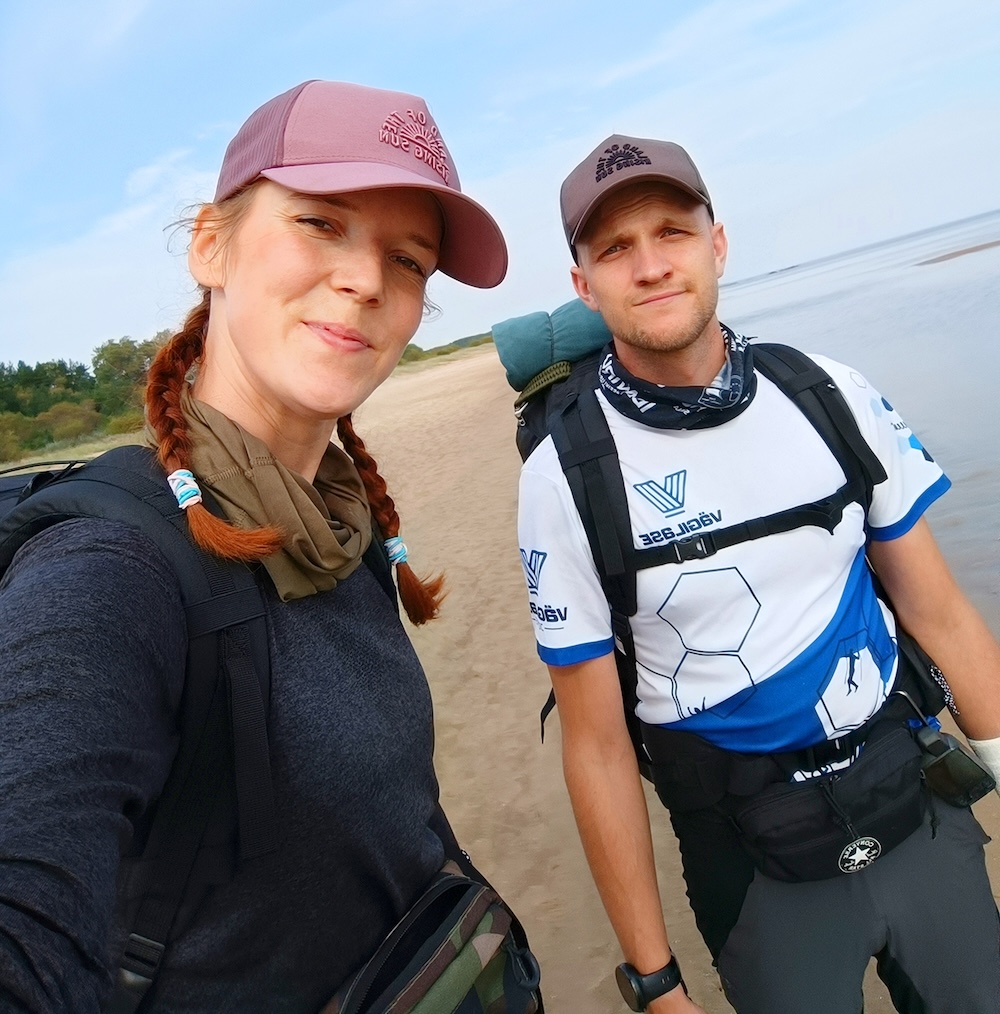
Encouraged by their success, the couple began planning a larger expedition. Estonia would have to wait, however, as Latvia seemed easier.
The project required thorough planning. The key was to find a route across Latvia that avoided large bogs, bodies of water, and cities.
Route planning is Toomas Erikso’s speciality.
“Drawing a line is not simple. You have to make sure it is actually passable and that there are no natural obstacles or things like industrial areas, fences or buildings in the way,” he explains.
It is also important to find the shortest possible route. In Latvia, this meant crossing the country at its narrowest point from south to north.
Preparation took several months and included scouting parts of the route in advance.
“We wanted to be sure it was truly possible to walk it. We checked a few locations beforehand.”
The Latvian crossing began in late October 2024 from the Lithuanian border, and continued to the Gulf of Riga coast. Over four days, the couple covered 75 kilometres.
Everything went surprisingly smoothly. The biggest challenge was the language barrier.
“We don’t speak Latvian, so we carried a sign explaining our journey in Latvian. There were a few tense encounters, but everything turned out well once people understood what we were doing,” Metsamaa says.
“We wanted to be as open as possible and not sneak through people’s yards.”
What about dogs in private yards—were there any dangerous situations?
“There were some dogs running loose, but fortunately the owners kept them under control,” Erikso says.
The couple had previously made videos of their travels, but after the Latvia trip they began producing their YouTube content in English. Their videos can be viewed on the Tomiti channel.
The Latvia journey became very popular, and many Latvians are among their thousands of followers.
“The most common question was about ticks,” Metsamaa laughs. None, however, were picked up during the trip.
What remained in their memory were Latvia’s beautiful farmland landscapes and autumn colours.
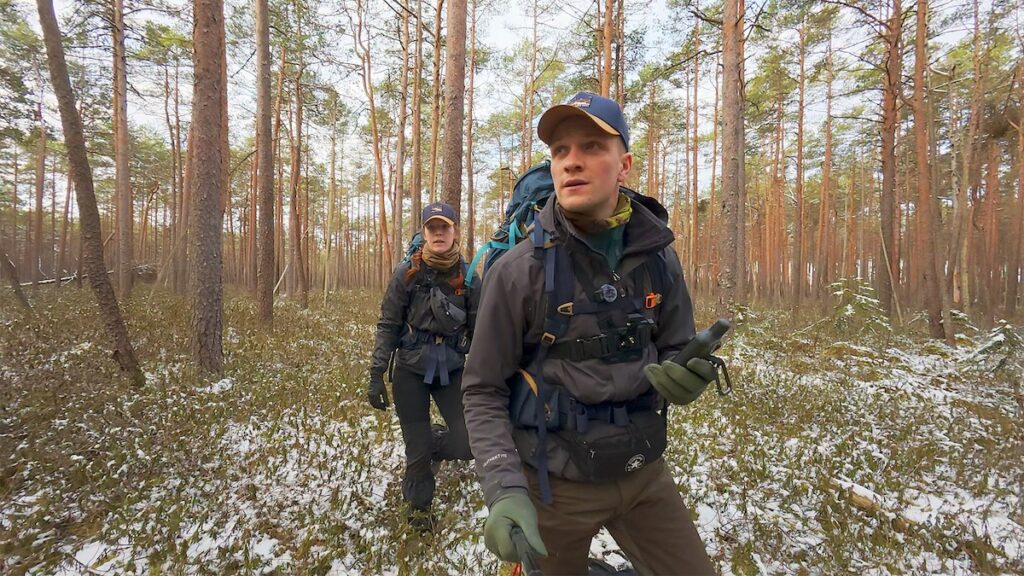
In spring 2025, it was time to cross Estonia. According to the couple, planning the Estonian route was much more difficult than Latvia. Estonia is longer north to south, and has more bogs, cities, and industrial areas.
“At first we considered a west–east route, but there were too many difficult sections—bogs, cities, military areas, and industry. So we chose a south–north line instead,” Erikso explains.
Eventually, they found a suitable route that avoided larger cities, bogs, rivers, and industrial zones. The starting point was Mõisaküla on the Latvian border, and the endpoint Vainupea on the Gulf of Finland coast.
The route measured approximately 176 kilometres, with eight planned overnight stops. The goal was to walk about 20 kilometres per day. Progress is slow, as the route does not follow paths or roads.
“You also have to constantly monitor the GPS to stay on course,” Erikso says.
The next step was preparing equipment. The day before departure, they placed supplies at the campsites, including hiding an inflatable kayak in the forest.
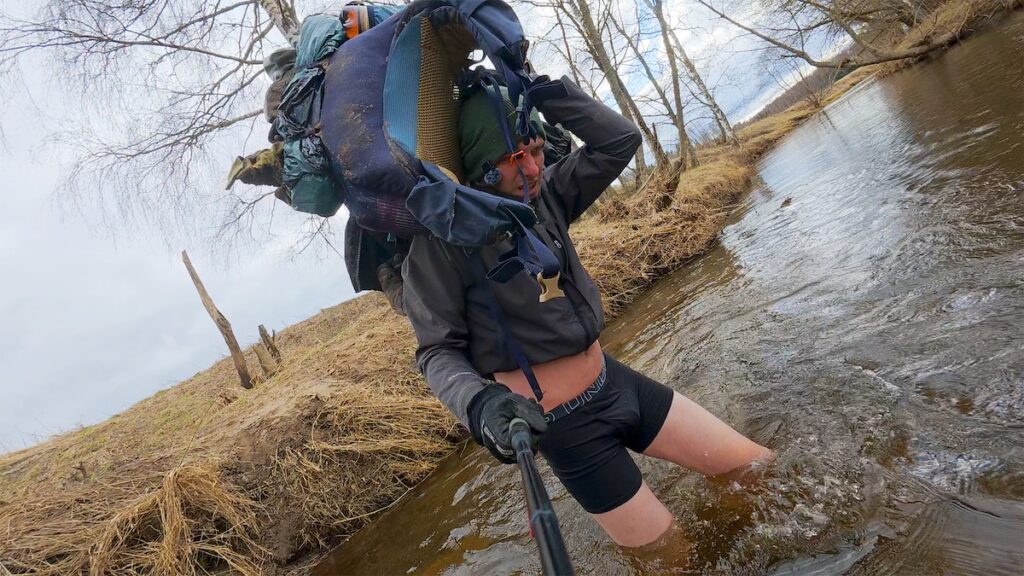
Although April began warmly, the hikers were met with winter conditions. During the nine-day journey, temperatures hovered around freezing, and snow fell several times.
“The weather was the biggest challenge. When the snow began to melt, the terrain became extremely wet, and we got thoroughly soaked,” Metsamaa says.
Old drainage ditches in peatlands also made progress difficult. At one point, they had to deviate slightly from the line, but still within the allowed limits—less than 50 metres.
Before the trip, friends had warned them about bears and other predators, but they only saw a few deer. The most tense situations involved loose dogs.
Throughout the journey, they met many local people, whose reactions were always positive.
“Meeting people was the best part of the trip. Everyone wonders what on earth we are doing in the middle of nowhere. People were very interested, and once we were even invited to a sauna,” Metsamaa says.
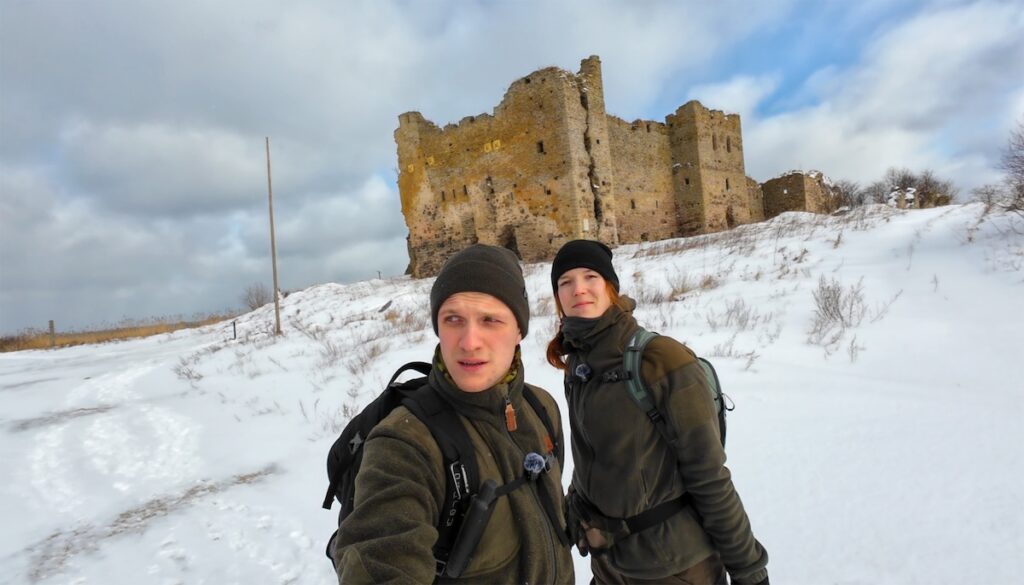
What was Estonia’s nature like along such a route?
“Routes like this don’t pass famous sights. You have to find beauty yourself—in trees, moss and small details. Unfortunately, there was a lot of young brush and less old, impressive forest,” Metsamaa says.
The most difficult moment came when Metsamaa’s old knee injury flared up.
“Still, we made it to the end. It was amazing to reach the destination despite the challenges.”
At the final campsite in Vainupea, the biggest surprise of the journey took place—Toomas proposed to Iti-Jantra.
“Well, after such an undertaking, I had to say yes,” she laughs.
According to the couple, their achievement is likely a world record in straight-line hiking. Their success has only increased their appetite for new challenges.
Next, they plan to walk across Lithuania.
“We are also already thinking about Finland—that’s ahead in the future.”
Their newest challenge is a coastal hike from Narva-Jõesuu along Estonia’s shoreline, continuing around the country to Latvia and on to the Lithuanian border.
This coastal route is more relaxed in style, allowing detours around harbours and reed beds. There are no strict rules this time.
“I’m from Saaremaa, and I’ve always dreamed of hiking along the coast,” Metsamaa says.
The coastal journey, which began in 2024, has taken them along the Ida-Virumaa coast to Lahemaa and westwards. By January 2026, they had covered over 400 kilometres, hiking on weekends and holidays.
“We were on the coastal route just last weekend, and reached Tallinn. Next time, we’ll continue west.”
Along Estonia’s northern coast, they have encountered many impressive sites. They particularly praise the stretch from Narva-Jõesuu to Sillamäe.
“It was easy to walk along the flat sandy beach—we did it in half a day,” Metsamaa says.
They also highlight Lahemaa, including the Käsmu peninsula and the village of Viinistu.
“We’ve also received great tips from our followers on where to go.”
For Finns, it may seem unusual that beaches can be freely accessed. This is a unique feature of Estonia’s public access rights. The “kallasrada” is a ten-metre wide public zone along bodies of water.
Both confirm that this is indeed the case. So far, they have been able to walk freely along the coast.
“Sometimes there are private property signs, but they cannot restrict movement along the shoreline.”
The biggest obstacles have been harbours and river mouths, which they have simply bypassed.
Three hiking tips in Estonia
- The former Aidu quarry area in Ida-Virumaa
“We are real fans of Aidu because it is so unique and diverse. We recommend the Aidu nature trail.” - Viidumäe and Koigi bog on Saaremaa
“A different side of Saaremaa—bogs and forest.” - Käsmu nature trail in Lahemaa
“Käsmu has a truly beautiful trail and unspoilt nature.”
What is straight-line hiking?
Straight-line hiking is a form of trekking in which the adventurer aims to cross a specific area or country in a straight line, typically on foot. This requires travelling directly through forests, hedges, and terrain obstacles. The goal is to explore remote areas that would otherwise never be encountered. Such expeditions often require thorough planning and preparation.
Videos of Iti-Jantra Metsamaa and Toomas Erikso’s journeys can be viewed on the Tomiti YouTube channel.
To learn more about this and similar topicsBog GPS navigation Hiking private land public access rights trekking